
Hello. This is Goyang Shinsegae Eye Clinic.
One of the biggest concerns for patients diagnosed with macular degeneration is intravitreal injection treatment.
“Does the medication really have to be injected directly into the eye?”
“Will one injection be enough?”
“Is there a large difference in cost depending on the medication?”
Wet age-related macular degeneration, in particular, can cause abnormal blood vessels to develop in the central retina, potentially leading to bleeding or swelling. Depending on the condition of the retina, active treatment may therefore be necessary.
In recent years, not only have more treatment options become available, but the introduction of biosimilars has also changed the financial burden associated with treatment.
Today, we will explain why intravitreal injections may be necessary for wet macular degeneration, which medications are commonly used, why costs differ, and what has changed in recent years.

1. Why Are Injections Needed for Wet Macular Degeneration?
Macular degeneration is generally divided into two types: dry and wet.
Dry macular degeneration usually progresses more slowly and is associated with the accumulation of deposits such as drusen in the retina.
Wet macular degeneration, on the other hand, involves the growth of abnormal new blood vessels beneath or within the retina. These vessels can leak fluid or bleed.
As a result, patients may notice symptoms such as straight lines appearing distorted, blurred central vision, or a sudden decrease in visual acuity.
Intravitreal injection treatment for wet macular degeneration commonly involves medications that inhibit VEGF, or vascular endothelial growth factor, which plays an important role in the development of abnormal blood vessels.
The primary goal is to suppress the activity of these abnormal vessels and help control retinal swelling and bleeding.

2. Which Medications May Be Used?
At an eye clinic in the Ilsan area, the choice of medication is generally based on several factors, including the condition of the retina, the activity of the lesion, and how the eye has responded to previous treatment.
Commonly used medications include Avastin, ranibizumab-based medications, and aflibercept-based medications.
Each option differs in its mechanism of action, approved indications, National Health Insurance coverage criteria, and cost.
For this reason, no single medication is appropriate for every patient.
✅ Severity of Abnormal Blood Vessels and Retinal Swelling
The ophthalmologist evaluates how active the lesion is and how much swelling or leakage is present.
✅ Response to Previous Medication
The response to previously administered injections is also taken into consideration.
✅ Health Insurance Coverage
Out-of-pocket expenses may vary depending on the examination findings, previous treatment history, and whether the medication meets the criteria for insurance coverage.
Therefore, when considering injection treatment for macular degeneration, it is more important to determine which medication is appropriate for the current condition of the eye than to compare medication names alone.
3. Do Eye Injections Hurt?
One of the most common concerns among patients receiving this recommendation for the first time is the idea of having medication injected directly into the eye.
During the actual procedure, the area around the eye is carefully disinfected to reduce the risk of infection, and topical anesthetic eye drops are applied before the medication is injected into the vitreous cavity.
Because the procedure is performed after topical anesthesia, most patients experience little significant pain, and the injection itself is usually completed within a short period of time.
The actual injection often takes only a few seconds, and many patients report that the procedure was less uncomfortable than they had expected.
Wet macular degeneration also often requires ongoing treatment rather than a single injection.
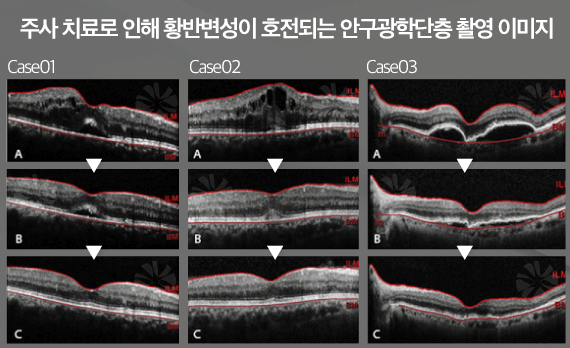
Tests such as optical coherence tomography, or OCT, are used to assess whether retinal swelling or bleeding has improved.
Based on these findings, the timing and interval of subsequent injections can be adjusted.
If severe eye pain, a sudden decrease in vision, marked redness, or other unusual symptoms occur after the procedure, it is important to visit an eye clinic promptly for evaluation.

4. The Introduction of Biosimilars Has Changed the Cost of Treatment
In the past, when certain injectable medications did not meet the criteria for National Health Insurance coverage, some patients faced out-of-pocket costs in the KRW 700,000 range.
As a result, some patients had difficulty choosing a medication that might be clinically appropriate because of the financial burden.
More recently, biosimilars have become available.
These medications are approved after demonstrating a high degree of similarity to existing biological medicines in terms of quality, efficacy, and safety.
As biosimilars have entered clinical use, the range of available treatment options has expanded.
Depending on the medication, insurance criteria, and pharmaceutical support programs, some patients may now receive treatment at a substantially lower cost, in some cases in the KRW 100,000 range.
However, the same price does not apply to every patient.
The actual out-of-pocket cost can vary depending on the medication used, insurance eligibility, the medical institution, and each patient's individual circumstances.
For this reason, it is most accurate to confirm the applicable cost at the time of consultation.

Even among patients with the same diagnosis of macular degeneration, the location and extent of the lesion, the activity of abnormal blood vessels, and the degree of bleeding or retinal swelling can vary considerably.
For this reason, it is difficult to determine your own treatment plan simply by comparing which medication another patient received or how frequently they were treated.
In wet macular degeneration, damage can accumulate in the part of the retina responsible for central vision.
Accurately assessing the current condition of the retina and beginning treatment at the appropriate time are therefore important.

In the past, the financial burden could be considerable when high-cost medications had to be used without insurance coverage.
Today, however, the introduction of biosimilars and other treatment options has provided patients with a wider range of choices, including options that may reduce treatment costs.
Even so, medication should not be selected based on price alone.
The condition of the retina, the response to previous treatment, and the applicable insurance criteria should all be considered when determining the most appropriate approach.
Many patients understandably feel anxious at first about having medication injected directly into the eye.
However, if intravitreal injection treatment is recommended for macular degeneration, it is important to review the examination findings carefully and receive a clear explanation of the medication being considered, the expected number of injections, and the potential cost.
Regular follow-up examinations also play an important role in long-term vision management, as the injection interval and choice of medication may need to be adjusted according to how the retina responds over time.
Thank you.