
Hello,
This is Goyang Shinsegae Eye Clinic.
As people age, many begin to notice that
small letters in books or on smartphones
are no longer as clear as they once were,
or that it takes longer for their eyes
to refocus when shifting their gaze
from a nearby object to something farther away.
These changes are associated with presbyopia,
which occurs as the natural lens of the eye
gradually loses its ability to adjust focus with age.
If cataracts develop at the same time,
vision may become generally cloudy or hazy,
and symptoms such as glare,
halos around lights, and changes in color perception
may also occur.
Today, when planning cataract surgery,
the goal is often not limited to simply
removing the cloudy natural lens.
Many patients also consider
how comfortably they would like to see
at different distances after surgery.
As more people seek to reduce their dependence on glasses
and achieve more comfortable vision
at both far and intermediate distances,
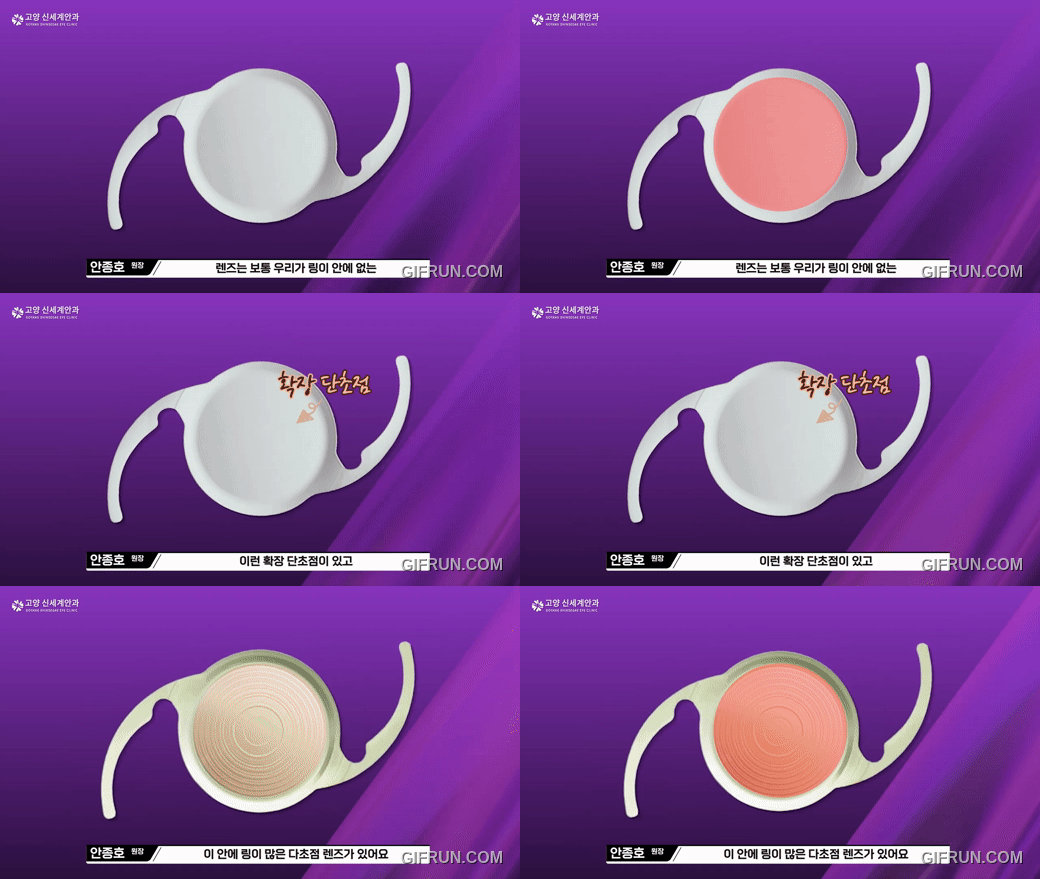
interest has grown in intraocular lenses
such as Vivity, PureSee, and Eyhance.
1. Why Is an Intraocular Lens Needed in Cataract Surgery?
The natural lens inside the eye
functions much like the lens of a camera.
It refracts incoming light
so that it can focus on the retina,
allowing us to see objects clearly.
However, as we age,
changes can occur in the proteins
and other components of the natural lens.
As a result, the lens may gradually lose its transparency
and become cloudy.
This condition is known as a cataract.
If a cataract progresses to the point
that reduced vision interferes with daily activities,
surgery may be considered
after an appropriate examination and consultation.
Cataract surgery involves removing the cloudy natural lens
and replacing it
with an artificial intraocular lens.
Because the range of focus
and visual characteristics after surgery
can vary depending on the type of intraocular lens selected,
it is important to consider
your lifestyle and visual needs carefully.
2. EDOF Lenses
EDOF stands for “Extended Depth of Focus.”
These lenses are designed
to extend the range over which vision remains clear,
allowing patients to see not only at a distance
but also at intermediate ranges.
Intermediate vision is frequently required
in modern daily life,
such as when checking a navigation screen
or dashboard while driving,
or when looking at a desktop computer monitor.
For this reason,
many patients are interested in EDOF lenses.

3. Main Advantages
① Natural Vision from Far to Intermediate Distances
EDOF lenses are designed
to provide a continuous range of focus,
helping patients see more naturally
across far and intermediate distances.
This can be helpful in many everyday situations,
such as checking the dashboard while driving,
working on a computer,
shopping, cooking, or performing household tasks.
② Potentially Reduced Glare and Halos
EDOF lenses are designed
with the aim of reducing optical disturbances
such as glare, halos, and light scatter.
For patients who frequently drive at night
or who place a high priority
on visual quality in dim environments,
they may be one of the options worth considering.
③ Relatively Good Quality of Vision
These lenses are optically designed
to minimize unnecessary light loss
and may help preserve contrast sensitivity
to a relatively good degree.
④ Smooth Transition Between Focal Distances
Another characteristic
is that the transition in focus
when looking from near to far distances
can feel relatively natural.
This may provide more comfortable vision
in everyday situations
where patients frequently shift their gaze
between objects at different distances.
4. Comparison of Common EDOF and Enhanced Monofocal Lenses
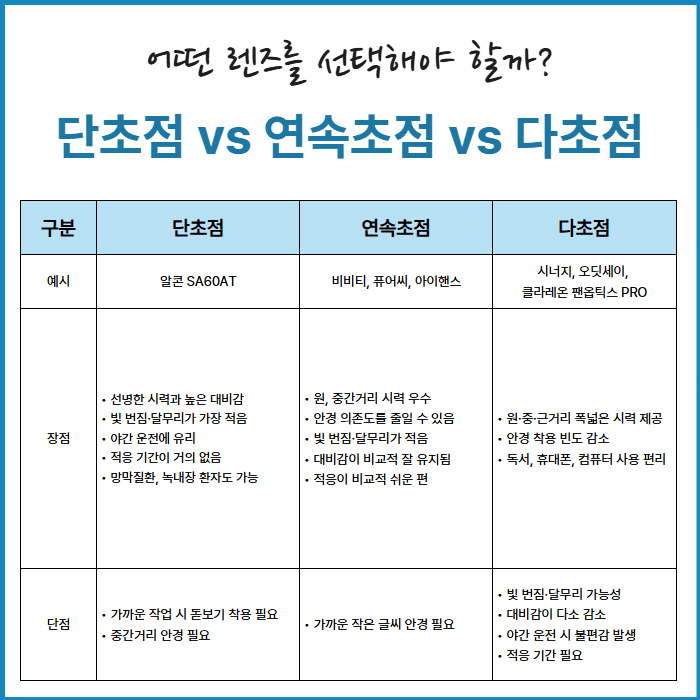
1) Vivity
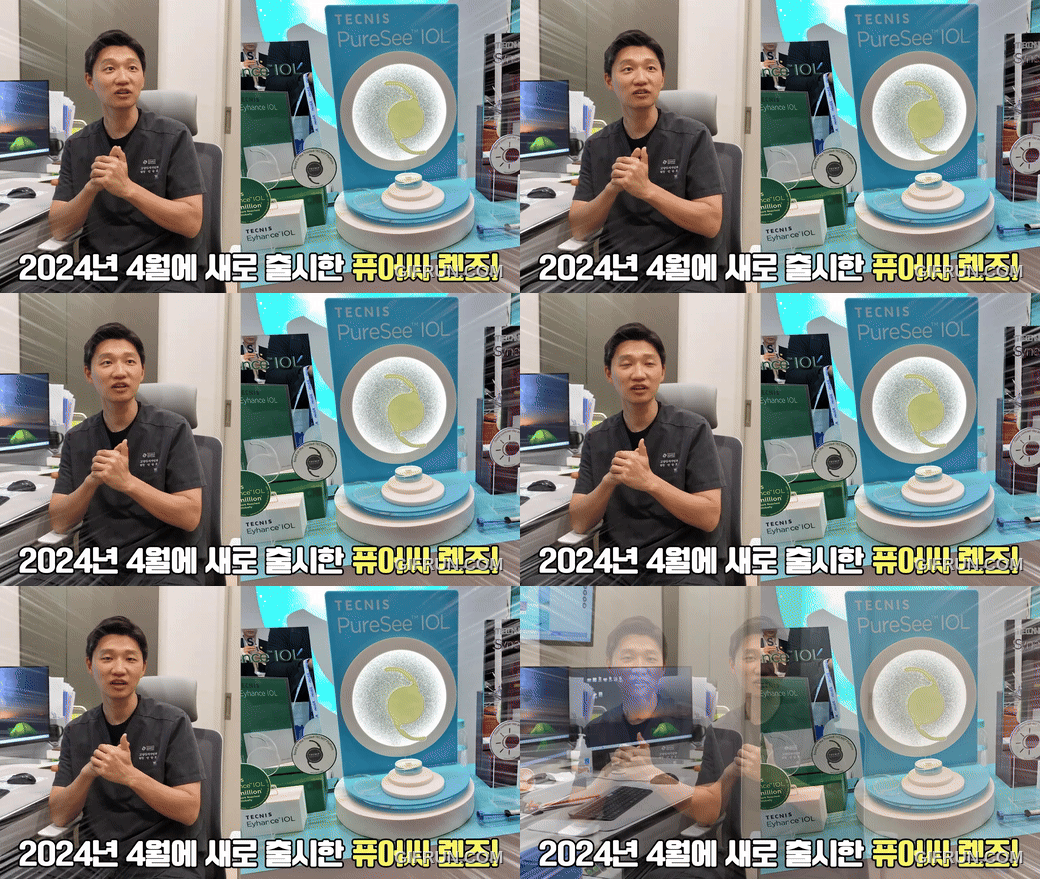
Vivity is a non-diffractive EDOF intraocular lens
developed by Alcon.
It is designed to provide clear distance vision
while extending the range of focus
toward intermediate distances
in a relatively natural manner.
2) PureSee
PureSee is an EDOF intraocular lens
developed by Johnson & Johnson Vision.
It is designed to continuously extend
the range of focus
from distance to intermediate vision,
providing a smooth and natural visual transition.
3) Eyhance
Unlike Vivity and PureSee,
Eyhance is classified
as an enhanced monofocal intraocular lens.
It is designed to preserve the advantages
of a conventional monofocal lens
while providing some improvement
in intermediate vision.
It may be considered by patients
who place particular importance on distance vision
but would also like
a somewhat broader range of vision
than that provided by a conventional monofocal lens.

5. Precautions After Cataract Surgery
When washing your face or taking a shower
after cataract surgery,
care should be taken
to prevent water from entering the eye directly.
The appropriate time to resume
normal face washing or showering
may vary depending on the patient's recovery,
so it is important to follow
the instructions provided by the medical institution
where the surgery was performed.
Prescribed eye drops should also be used
regularly according to the recommended dosage and schedule.
Patients should not reduce the frequency
or discontinue the medication on their own.
It is also advisable to avoid
rubbing the operated eye
or engaging in activities
that may place excessive pressure on the eye.
If necessary,
an eye shield may be worn
for a certain period of time
according to the medical team's instructions
to help protect the operated eye.
Regular follow-up examinations
should also be attended as scheduled
to monitor visual recovery,
check the healing process,
and ensure that no unusual problems have developed.